
SEYON VALAM
The Bedrock of Tamil Cultural Identity
The trip to Aarupadai Veedu is to walk through the living history of Tamil Nadu. It is not just a pilgrimage to six sacred shrines but a journey across an ancient cultural landscape where poetry, social ethics, geography, and the evolving spirit of Lord Murugan merge into a single, continuous narrative.
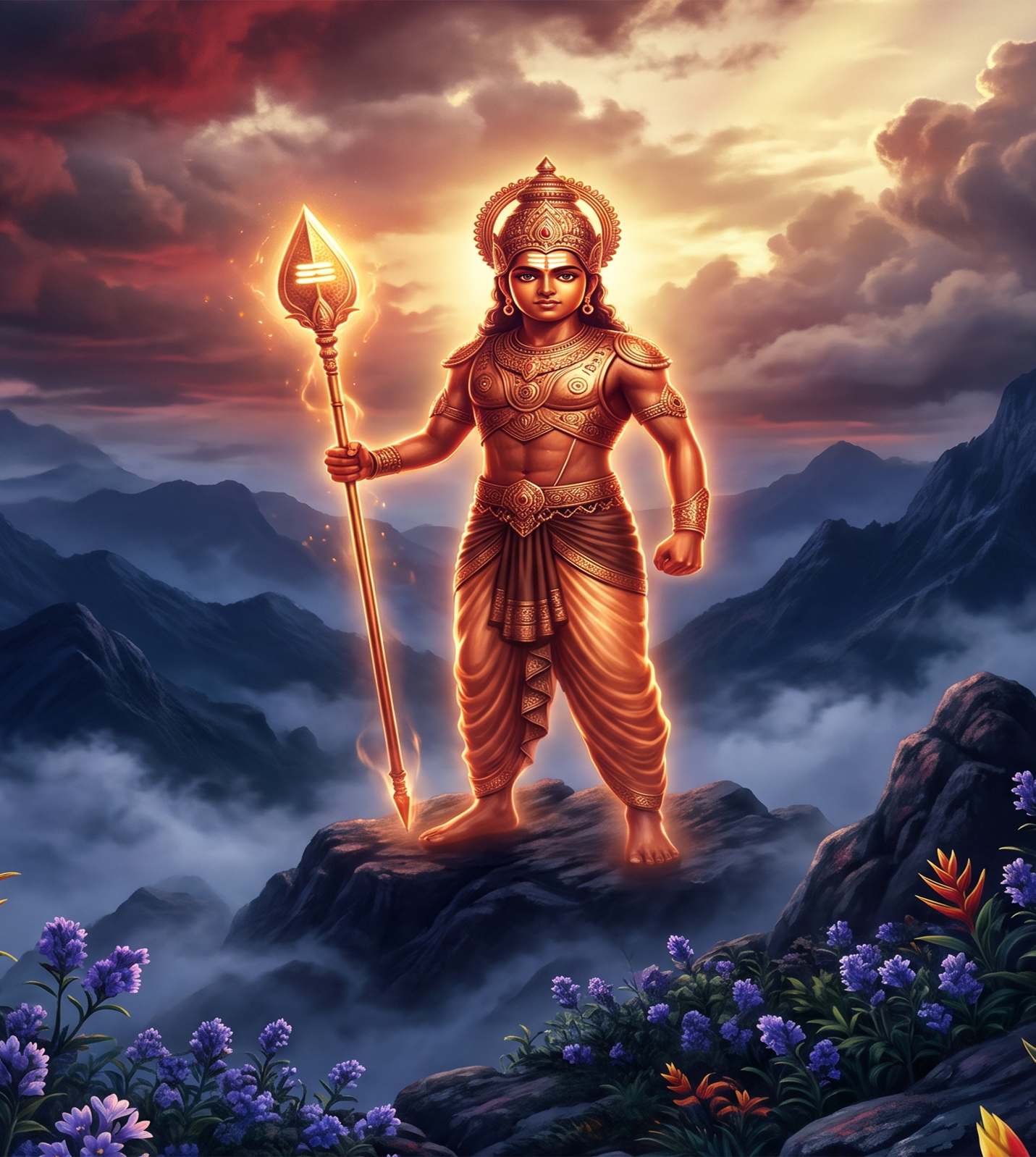
In Tamil culture, spirituality is intricately woven into geography, literature, and identity. At the heart of this cultural ecosystem stands Lord Murugan—anciently known as Seyon. His spiritual presence is anchored in six revered shrines in Tamil Nadu known as the Aarupadai Veedu. Unlike conventional temple clusters, the Aarupadai Veedu forms a sacred geography that maps out the literary, ecological, philosophical, and social consciousness of the Tamil people. From the Sangam bards of antiquity to modern global pilgrimages, these six abodes serve as the primary spiritual and cultural backbone of Tamil civilization.
Cultural Odyssey and Spiritual Journey
The sacred grouping of these six temples was formalized in Sangam literature through the treatise Tirumurukarrupadai , written by the celebrated bards Nakkirar in the 3rd or 4th century CE. “Arrupadai” Genre: In Sangam poetry, Arrupadai was a genre where a guide directs an itinerant poet toward a generous patron. In Tirumurukarrupadai, Nakkirar guides spiritual seekers to the six abodes of Murugan to receive divine grace.
It is considered the first devotional poem in Tamil literature (part of the Pattupattu or Ten Idylls). In classical Tamil poetics, Arrupadai was a literary form where a traveller (a poet, dancer, or musician) who had received gifts from a generous king guided another struggling traveller toward the same patron. Nakkirar innovated this tradition by transforming it into a spiritual journey: a devotee who has experienced the grace of Lord Murugan directs other spiritual seekers to his six abodes. Through this text, geography was transformed into theology, establishing a pilgrimage circuit that has endured for over two millennia. In the collective consciousness of the Tamil people, Lord Murugan is not merely a deity residing within a pantheon; he is Tamil Kadavul—the divine personification of the Tamil language, culture, youth, and landscape. The word Murugu itself in ancient Tamil signifies threefold divinity: Beauty (Azhagu), Youth (Ilaimai), and Divine Grace (Inbam). The Aarupadai Veedu (Six Holy Abodes) functions as the spiritual, linguistic, artistic, and social nervous system of Tamil Nadu. Over two millennia, these six temples have shaped Tamil civilizational identity—influencing how Tamils speak, write, dance, sing, celebrate, eat, and structure their society.
Tirupparankunram – The Abode of Martial Triumph and Celestial Alliance
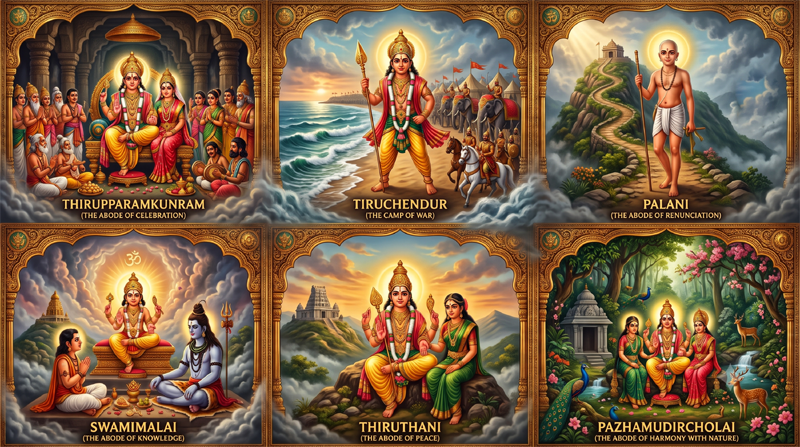
Situated on a massive granite outcrop near Madurai, Tirupparankunram is traditionally enumerated as the first abode (Prathama Kshetra) of the Aarupadai Veedu canon. Literary Antiquity: Explicitly attested in classical Sangam literature, including the Tirumurugatrupadai and Paripadal. Rock-Cut Architecture: Houses an early cave temple complex showcasing significant patronal contributions from the Early Pandya dynasty (6th–8th centuries CE). Heterodox Inscriptions: The hill features Jain ascetic beds (Pazhiyangal) alongside early Tamil-Brahmi epigraphs, testifying to the long-standing multi-religious sacred use of the landscape. Following the cosmic victory over the demon Surapadman, Murugan wed Deivayanai (Devasena), the daughter of the Vedic deity Indra, at this site. Consequently, the sanctuary functions as a locus of martial victory (Vijaya), sovereign governance and civic responsibility (Dharma), sacralized kingship, and the divine union of action and grace (Kriya Shakti). Cave Architecture: Subterranean and rock-cut sanctuary design carved directly into the living granite monolith. Sculptural Heritage: High-relief monolithic iconography depicting various deities of the Hindu pantheon. Epigraphic Wealth: Extensive Pandya and later Nayaka-period epigraphs documenting royal endowments. Syncretic Worship: Displays a rare composite Shaiva–Vaishnava–Murugan iconographic arrangement, reflecting early sectarian integration.
Tiruchendur – The Maritime Landscape of Cosmic Order
Positioned directly upon the littoral margin of the Gulf of Mannar (Bay of Bengal), Tiruchendur (Jayanthipuram / Alaivai) is the sole coastal shrine among the six abodes, breaking the hilltop archetype. Maritime Node: Historically functioned as an important coastal shrine along Indian Ocean trade networks. Global Footprint: Epigraphic and classical records indicate visits by seafaring merchants, traders, and travellers from the Roman world, Arabia, and Southeast Asia. The Cosmic Battlefield: Site of the decisive combat (Surasamharam) wherein Murugan vanquishes Surapadman. Ritual Performance: The annual Skanda Sashti festival culminates in a dramatic theatrical reenactment of this cosmic battle along the shoreline. The Oceanic Chaos: The turbulent ocean represents primordial chaos, delusion (Maya), and the unstructured ego (Anava). Cosmic Order: Murugan embodies the stabilizing principle of cosmic order (Dharma) and illuminating wisdom (Jnana). Soteriological Triumph: The victory symbolizes the ontological triumph of divine consciousness over existential ignorance.
Palani – The Sacred Topography of Renunciation and Alchemical Tradition
Rising atop the Sivagiri hill in the Dindigul district, Palani (Tiru Avinankudi) ranks among the most frequented pilgrimage destinations in South Asia.
According to Puranic lore, Murugan withdrew to this hill as an ascetic (Dhandayuthapani) after relinquishing a competitive contest for the Jnana Pazham (Fruit of Cosmic Wisdom). Lord Shiva consoled his son with the declaration: "Pazham Nee" ("You yourself are the fruit.") While contemporary historical linguistics regards this etymology as a devotional folk explanation rather than a philological origin, the narrative remains deeply embedded within the Tamil cultural imagination. The temple is inextricably linked to Siddhar Bogar, an alchemical master traditionally credited with fashioning the primary icon of Dhandayuthapani from Navapashanam—a complex amalgam of nine mineral poisons transmuted into an inert, bio-medicinal compound. Although this narrative belongs to the Siddha esoteric corpus rather than empirical archaeology, Palani developed historically as a paramount center for:
Siddha pharmacology and medicine, Esoteric alchemy (Rasa Shastra), Hatha Yoga and ascetic practices, Botanical and herbal expertise, Absolute renunciation (Vairagya), Self-realization (Atma-Jnana), Liberation from the egoistic self (Ahankara)
Swamimalai – The Epistemological Reversal and Hierarchy of Wisdom
Constructed upon an artificial hillock (Kattu Malai) in the fertile Cauvery delta near Kumbakonam, Swamimalai (Eragaram) is unique for its inversion of divine hierarchies. Murugan manifests as Swaminatha (the Teacher of the Lord of the Universe), imparting the esoteric meaning of the primordial syllable OM (Pranava Mantra) to his father, Lord Shiva. This episode establishes an epistemological reversal that emphasizes: The primacy of realization over institutional or age-based hierarchy; wisdom transcending physical age and lineage; spiritual authority validated by direct ontological realization (Jnana) rather than seniority. Structural Evolution: The temple complex displays structural foundations from the Middle Chola period (10th–11th centuries CE), supplemented by extensive Nayaka-period additions. Chronological Symbolism: The 60 flight steps leading to the elevated sanctum represent the 60-year Jovian calendar cycle (Samvatsara), denoting dominion over temporal time.
Tiruttani – The Topography of Serenity and Reconciliation
Located on the hill slopes of northern Tamil Nadu (Kunruthoradal), Tiruttani marks the geographical and thematic transition of Murugan from a warrior deity to a peaceful divinity. Following the conclusion of the war at Tiruchendur, Murugan retreated to this hill to cool his wrath (Thani meaning “to cool” or “to calm”). The shrine symbolizes: The attainment of inner peace (Shanti), emotional balance and spiritual equilibrium; reconciliation and divine love (marrying the indigenous princess Valli); meditative stillness following spiritual struggle. Historically, Tiruttani occupied a key strategic position along overland transit corridors connecting the northern Tamil country (Tondaimandalam) with the Andhra region, facilitating cross-cultural exchange.
Pazhamudircholai – The Forest Sanctuary of Wisdom and Ecological Harmony
Nestled within the forested Azhagar Hills near Madurai, Pazhamudircholai preserves the ancient eco-poetic landscape celebrated in Sangam literature. The celebrated Sangam poetess Avvaiyar encountered Murugan disguised as a young cowherd sitting atop a rose-apple (Jambu) tree. The boy challenged her by asking whether she wished to eat “roasted fruit” (sutta pazham) or “unroasted fruit” (sudatha pazham). When Avvaiyar blew dust off the warm fallen fruit, the boy playfully asked why she was blowing on it to cool it down, revealing that even supreme intellectual scholarship requires profound spiritual humility (Vinayam). The site preserves the ecological characteristics of the Sangam Kurinji (mountain) and Mullai (forest) biomes, characterized by: Dense, biodiversity-rich forest canopy; natural perennial springs (Nupura Ganga); fruit-bearing flora and wildlife habitats; Indigenous medicinal plant sanctuaries; Spiritual maturity and fulfilment; Compassion toward all living beings; Synthesis of intellectual wisdom (Jnana) with absolute humility (Vinayam)
The Aarupadai Veedu stands as a magnificent testament to the rich tapestry of Tamil spiritual heritage, literary genius, and artistic magnificence. Each of the six shrines offers a unique window into the multifaceted nature of Lord Murugan—as a warrior, an ascetic, a teacher, a lover, a reconciler, and the ultimate giver of grace. For centuries, these holy abodes have bridged the divide between the material and the spiritual. The Aarupadai Veedu represents an integrated cultural system where science, ecology, art, and philosophy meet: Scientifically, it preserves ancient Siddha alchemical knowledge, architectural physics, and calendrical systems. Ecologically, it honors and protects the diverse biomes (Ainthinai) of the Tamil landscape. Culturally, it unites classical Tamil literature, folk music, classical performing arts, and global diaspora identity.
Philosophically, it offers a psychological roadmap for overcoming ego and awakening inner wisdom.
Thiruparankundram:
The soul begins its journey bound in Maya (the worldly illusion of marriage, duty, and social structures).
Tiruchendur:
The soul confronts Anava (the root impurity of the ego, personified by the demon Surapadman). Through divine intervention, the ego is severed and subdued.
Palani:
The soul sheds Karma and worldly attachment through Vairagya (renunciation), realizing that material wealth and status are transient.
Swamimalai:
The soul receives Jnana (Divine Wisdom) directly from the Supreme Teacher (Guru).
Thiruthani:
The soul achieves Shanti (peace), free from the turbulence of desire and delusion.
Pazhamudircholai:
The soul experiences Anubhuti (Direct Realization/Grace), where it merges into cosmic harmony.
The philosophy of the Seyon Valam teaches that God is not an external ruler to be placated but the supreme truth (Jnana) to be realized within oneself. The outward pilgrimage across these six physical sites is complete only when it awakens the pilgrim to the eternal temple dwelling within their own heart.